I've been watching a lot of old TV shows the past few months, in preparation for some trivia contests that I play in each year. This year I happened upon an old western that I hadn't seen before but which I found quite enjoyable: Tate.
Tate has the distinction of being the first TV program to feature a main character with a physical disability. Tate (his first name was never given) was a veteran of the Civil War, and had lost the use of this left arm in that bloody conflict. He wears a special leather sleeve-like sling on his disabled arm. Other than that, Tate is perfectly healthy, which is good, since he makes his living as a fast-drawing bounty hunter. As with most bounty hunter-styled TV westerns, Tate is very particular about which bounties he tries to collect. He has no real problem switching sides when he discovers he's on the bad guy's side of the situation, that way his story can be told without interference from Standards and Practices.
David McLean starred as Tate, playing the gunfighter as a taciturn man with not only the brains and willpower to do a lot of dirty jobs, but one with a soul and a conscience. McLean had already gained fame as the Marlboro Man in commercials and advertising for Marlboro Cigarettes (a product he later was a vocal opponent of when he contracted lung cancer).
The show was definitely not wanting for acting talent. Royal Dano, Leonard Nimoy, Robert Culp, Julia Adams, Robert Redford, Martin Landau, James Coburn, Frank Overton and Warren Oates all had prominent guest-starring roles on the program. Landau and Overton were particularly forceful in their roles; Landau portrayed a sheepherder who was wanted for the wanton destruction of a town in vengeance for the murder of his wife; and Overton portrayed one of Tate's closest friends, a man with no forgiveness in his heart for even the most trivial of wrongs. Culp also plays an excellent role as a principled but rather strange bounty hunter who tried to bring in Tate for a crime he was wrongfully accused.
A clip from "Comanche Scalps", featuring David McLean, Frank Overton and Leonard Nimoy.
The show lasted 13 half-hour episodes, all of which are now available on DVD. The show had been a summer replacement for part of Perry Como's Kraft Music Hall and apparently the ratings didn't justify a further investment by the program's sponsor, Kraft Foods.
If you have Netflix, Tate is a series that is definitely worth renting and experiencing. It doesn't have the wry humor that many good westerns, but it has a dramatic punch to it that few other TV westerns had in that era.
M.A.R.S. Patrol Total
War was one of the better comics that Gold Key put out in the late sixties
that wasn’t a licensed property, like The
Flintstones or Voyage to the Bottom
of the Sea. This comic, while well written and having good art, only lasted
for seven issues over the course of about three years.
The title was originally called just Total War, probably to capitalize on a popularity spurt of war
comics. The action centered on the Advanced Training Squad from the Marine
Attack Rescue Service. The squad was a
multicultural group that consisted of African-American communications expert Sgt.
Joe Striker, tank and weaponry specialist Corporal Russ Stacey, Asian-American underwater
combat expert Sgt. Ken Hiro and the team’s leader, combat pilot Lieutenant Cy
Adams. The highly-trained M.A.R.S. was under the leadership of General Kripps and had access
to the most modern of military weaponry and vehicles. The squad was on a 24-hour leave in a big city
when the metropolis was suddenly attacked by a very well-equipped and manned
military force. Over the course of the series, little was actually revealed
about the invaders; they were bald, hairless and had metals unknown to human
science. They also had various fantastic devices that were improved versions of
current weapons or systems on Earth. While it was implied that the invaders
were aliens, it was never actually revealed.
Given that M.A.R.S.
Patrol wasn’t published by one of the Big Two, there was a surprising
amount of decent characterization in the series, as several missions sent the
Squad back to the home region of several of the members: Striker returned to
his home in the Louisiana Bayou and Hiro met up with an old friend in San
Francisco’s Chinatown. You get a feeling of the horror of war as the United
States becomes one of the major battlefields in this global conflict.
Every issue but the final seventh one also had a
fully-painted cover, and the first two issues had artwork by comics’ legend
Wally Wood, the first I actually recall seeing in a Gold Key comic. All seven
issues are readily available in the various internet comic hubs, and I think
they are worth checking out for any war comics fan.
Now unlike M.A.R.S.
Patrol, it is kind of difficult to know what to think about Zody the Mod Rob. This was a comic
published in the middle of 1970, well after the supposed end of the Love
Generation. I’m not quite sure what the single published issue of this series
is trying to be; is it an Archie-style
teen comic? Is it a counter-culture humor title? I’m not saying that it is a
bad comic. It is actually quite well written for a “funny book” but it seems to
have been published in the wrong decade.
Randy Martin was trying to get on the staff of the Tinker
High Times newspaper, and was assigned to get a story from an eccentric
scientist named Professor Ipsof Acto, a man who didn’t know what his own
birthday was and was obsessed with horoscopes. Since Randy was an Aquarius,
Acto gave him his special Horoscope Cap to wear, which endowed Randy with a
level of prescience after he fell asleep outside wearing the device. Knowing
the future put a crimp in Randy’s life, so he built a robot and put the cap on
it. After a night being bathed in starlight through a skylight, the robot, named
Zody, started talking and acting strangely, proclaiming it had an IQ of 800.
The remainder of the tale dealt with Randy trying to deal with the
still-prophetic statements of Zody, who was given a wig to cover the cap and
dressed like a very thin hippie-stereotype.
The only thing that comes to mind after reading Zody the Mod Rob is DC’s legendary
stinker Brother Power, the Geek. Here
we have another attempt by a group of old white men trying to interpret a youth
movement without much of a clue as to what they were doing. In both cases, at
least there wasn’t a lot of vitriol and hidden agendas behind the attempts. Zody actually seemed to have some
potential as a series, but I think the lack of a real direction hurt it. It’s
like watching the first episode of My
Mother, the Car: It’s a mildly interesting concept when you get past the
blatant stupidity of the idea. Zody the
Mod Rob was about ten steps above that. This is another title that’s available
digitally from various sources on-line. One issue and ten minutes at the most
of your time is all it takes to give the entire saga a read.
Later this week, some reviews of some classic TV shows!
About six months ago, you might have seen a vanguard of
television commercials promoting DC Comics’ “New 52” line. The company that has
published such icons as Superman, Batman and Wonder Woman for nearly a century
decided to completely remake their comic book series, to make them more
accessible to new readers. DC had
attracted some of the best writers in comics, such as James Robinson, Geoff
Johns and Grant Morrison to reboot their characters for the 21st
century in fifty-two separate comic book series. Since they’ve rebooted their
comic book universes about six times in the past two decades, I was a tad
skeptical that this would last. It does seem that there won’t be going back for
DC Comics, but I have the feeling that quite a few of those 52 series won’t be
here next year. There are a few true gems in this new DC universe, and a bunch
of definite clunkers, but there are even more titles that just straddle the
line and do nothing for me.
My favorite titles so far are:
Aquaman
I think I would have to say that Aquaman ranks as one of the best, or perhaps even the best, of the
New 52 titles. Excellent artwork and some of the best scripting I’ve seen in a
long while. Aquaman and Mera are trying to make their own lives in the surface
world. The first story arc has the King of the Seas and his wife battling both
ancient sea creatures and misapprehensions by landlubbers about who and what
the two Atlanteans really are. There are plenty of hints given to both
characters’ revitalized pasts, more than enough to pique the interests of even
casual Aquafans. If they can keep up this sort of quality in the future, I
think Aquaman finally has a future as a major DC character, even without a
movie or cartoon push. I would definitely suggest readers get the trade
paperback of the first story arc when it comes out.
Suicide Squad
For those who haven’t read many comics, the Suicide Squad is
a group of government-sanctioned operatives that have been around since the
early sixties. The initial team was a team of military operatives and
adventurers, but former X-Men artist John Byrne created the current team
dynamic in which the Squad is made up of super-villains, who get their
sentences reduced or commuted if they successfully finish their missions … and,
of course, if they manage to stay alive. One interesting thing about this group
is that the members do in fact die, and die quite often. The New 52 incarnation
features a team centered on long-time Squad member Deadshot, with the popular
Harley Quinn as an added attraction. Other members include a rebooted and
apparently reformed Black Spider, the monstrous King Shark, and a new version
of the old DC western hero El Diablo, along with a lot of newer villains along
for cannon fodder. The stories are intricately-plotted and interesting. The
first issue follows the new Squad’s indoctrination and first mission, which was
to kill everyone in a sealed football stadium. The artwork is very good, the
action is quick, and the character well-voiced. The only bad thing about the
New 52 Suicide Squad is the fact that Amanda Waller, the group’s
behind-the-scenes leader, went from being a somewhat portly black woman into
your standard near-super-model type. I think this takes a lot of force from the
character’s personality and was a very poor decision. Not everyone in a comic
book is a superhero and they don’t all have to have super-heroic physiques.
And the two titles that I currently think are pretty much
crap so far are:
Justice League
I mentioned this title in a previous blog, and it has
definitely lived up to my low expectations. So far, it’s just been a dark and
gritty version of the Super Friends:
Galactic Guardians cartoon. There really hasn’t been anything in this title
that hasn’t been a cliché, and considering that it has been hailed as the
line’s flagship title, that’s a shame. The only redeeming feature is that
Aquaman, as in his own title, is now more bad-ass than he was in Grant
Morrison’s JLA title in the early
2000’s. While the first six issues were bogged down with the retelling of this
Justice League’s origin, the nineties-style artwork and the dark feel does
nothing to make me feel that this is the
Justice League. And while I’ve always liked Cyborg as a character, the token
nature of his appearance here belittles the good characterization he had under
the reigns of Marv Wolfman and George Perez in the original New Teen Titans title.
The next story arc is going to have to blow me out of my
chair to keep me from just ignoring this book.
Hawk and Dove
I think by now everyone one should know that an important
adage in comics is “Don’t let Rob Liefeld draw your comics! And for Raptor
Jesus’ sake, don’t let him write it!” Perhaps fortunately, he’s only drawing
this book, making it the most poorly drawn comic in the whole New 52 line. I
will say that Liefeld has improved his artwork since his last company-wide
attempt at revamping (Marvel’s regrettable year of “Heroes Reborn” back in the early
nineties), as a good number of the humanoid figures in Hawk and Dove are actually recognizable as human beings.
The book does recognize the prior incarnations of the characters,
which were created in the late sixties by legend Steve Ditko, and revamped in
the late eighties into a male and female team (instead of brothers).
Unfortunately, the last two Hawk and Dove
revivals met with sad fates; the second was pretty much ignored, and the first
fell prey to spiteful writers and editors who couldn’t handle the fact they had
devised a crossover event with a plot more transparent than air. Armageddon 2001 featured the
introduction of a powerful, time-bending character called Monarch, who was
formerly a super-hero. The fans, fueled by the burgeoning influence of the
internet, guessed right away that Monarch was originally intended to be Captain
Atom. To show up everyone who guessed that, the writers decided suddenly to
make Hawk into Monarch, and having the female Dove killed in the process.
Hawk and Dove are now the Avatars of War and Peace.
(Previously, the team had served a God-like voice, and also were said to have
been created by a Lord of Order and a Lord of Chaos who were in love.). There are
a number of Avatars for both sides, which have apparently been in existence for
several hundred years. We see the initial villains, Condor and Swan, kill an
Avatar called the Osprey to get his power. Dove is in love with Deadman. Hawk is
pretty much brain-dead and brutish, not bothering to think twice about picking
a fight with Robin. I suppose he doesn’t know that Robin’s been trained by the
League of Assassin and is Batman’s son, but when Batman is in the picture, even
in the farthest corner, you don’t mess with him or his. There’s a clichéd subplot
of a mad scientist with an army of “monsters of mass destruction” out to get
Hawk and Dove for stopping him from bringing down the Washington monument, and
a DC cop who is willing to work with the pair, but may or may not have an
agenda of his own. Hawk’s father, a Washington judge, also plays a supporting
role in the first few issues.
The book is just poorly done on all levels: Mediocre art, dull
scripting, less-than-vibrant characterizations. This is one of those series I
tried to like, since I’ve enjoyed two well-done versions of the duo, but this
comic book can’t rise above the many faults in it. I might give it a second
chance if the book gets a decent artist like most of the New 52 have managed to
do, but I think issue #6 is the end of the New 52 Hawk and Dove for me.
See you folks later this week! I have no idea what my next topic will be, but I'm sure something will hit me.
If you were growing up hooked on Saturday morning cartoons
in the seventies, there were only two rock groups for you: Josie and the
Pussycats and Butch Cassidy and the Sundance Kids. They were the serious
hard-rocking (at least as hard as bubble gum music can be) cartoon bands, since
Rick Springfield was a solo act on Mission:
Magic, the Archies were slowly fading away and into history with the
Bicentennial, the Chan Clan didn’t really play all that many gigs, Partridge Family 2020 was lame no matter
how you look at it, and the less said about Jabberjaw
and the Neptunes the better.
Having just watched every episode of each cartoon show, I thought it was time for a battle of the bands:
VS.
Both the Pussycats and the Sundance Kids have attained a bit
of cult status based on only three seasons worth of total episodes. Let’s take
a look at the two bands.
The Sundance Kids were actually a group of four espionage
agents and their drummer’s pet dog. A massive computer known as Mr. Socrates
would call Butch Cassidy, the only member of the band with a communication link
to their base, in the form of a radio ring.
In the group, Butch played lead guitar and handled lead vocals. He was
like a young James Bond, but with cartoon luck instead of James Bond Luck
(which as everyone knows, is only about 9/10ths as good as having Captain James
T. Kirk Luck).
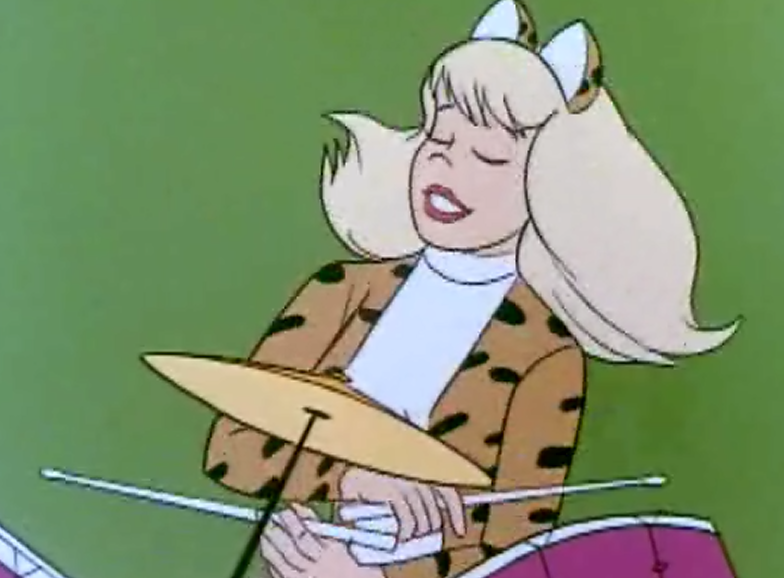
Merrilee was the blonde girl who played tambourine. She was
both a bit aggressive and a bit clumsy. Stephanie played bass guitar. She seemed to have more technical know-how
than anyone but Butch.
Steffy's brother Harvey was the drummer, who was rarely up for
the many adventures they had, preferring to stay at home where it was safe. The character was voiced by the only celebrity in the cast, Mickey Dolenz of the Monkees.
Elvis was his dog who went along on their adventures, often
being more useful than anyone else except Butch. He was also there every week
for the opening bit of comedy relief, as Mr. Socrates was somehow allergic to
Elvis. I’d like to think it was a built-in glitch that allowed the
supercomputer to function faster in the end, but really it was just a bad joke
that got out of hand and very old after episode three or four.
Along with being what appeared to be pop stars akin to the
Beatles, the Sundance Kids had access to loads of high-tech equipment,
including a special jet and automobile. Their cover story usually had them
booked playing some sort of benefit concert in a foreign country that had spy
work that needed to be done.
Contrasting the organization of Butch and his friends, Josie
and the Pussycats were considerably more slapdash. The band was popular, but no
crowd ever broke through the barricades to try to steal pieces of their
clothing for souvenirs, as the fans of the Sundance Kids were apt to do; the
Pussycats were more wont to ramble into a town for a concert on the backs of
donkeys or in rickshaws, or ending up swabbing decks to pay for their passage on a ship (because of Alexander's lack of business legerdemain).
Josie played lead guitar and did most of the vocals for the
band.
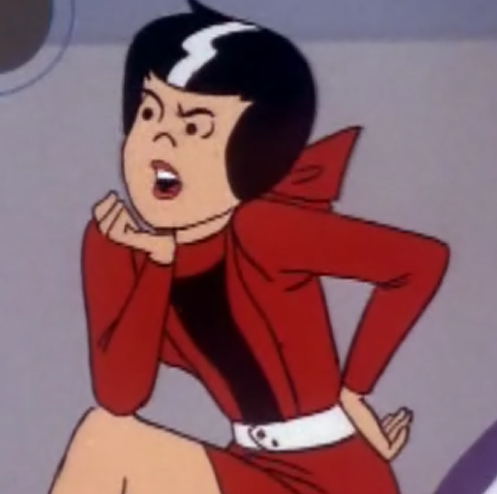
Valerie was the African-American teen who played tambourine
(and could give MacGuyver a run for his money in the brains department). The scatterbrained Melody was the drummer.
On the sidelines, Alan was the group’s road manager (or just
their roadie; it was often hard to delineate exactly what Alan’s job was,
besides being the clean-cut strongman and love interest) and was the apple of
Josie’s eye…
…and the eye of Alexandra Cabot, the sneaky and troublesome
sister to the group’s easily frightened manager, Alexander Cabot III.
The band was rounded out by Sebastian, Alexandra’s cat who,
like Elvis, was often of more use on an adventure than most of the others.
Alexandra also secretly hoped to wrest creative control of the band from Josie
to make the kind of music she liked, though what that might be was never quite
explained.
As you can see, the dynamics of each band were somewhat
similar up to a point. Both had an integral pet, an easily-terrified goober for
comedic double-takes, and at least one person who was smart and technically
inclined. The Pussycats had the added problem of having a member of their group
constantly plotting to take it over, which was almost in diametric opposition
to Mr. Socrates on Butch’s side. None of the Sundance Kids accidentally fouled
up a plan because they were trying one up or trying to vie for the amorous
intentions of one of their bandmates.
So which was the better band? Musically, they were both
better than the Archies, given the snippets of original songs viewers heard in
each episode. Of course, being noted as being better than the Archies is akin
to being called nicer than Hitler, so that isn’t saying too much. Since every song used the same animation to
show the band performing, at least Hanna-Barbera went to the trouble of
rotoscoping (animating over film of real-life performers) some folks to get the movement right, down to the motion of the
girls’ hair. Of course, that also meant that every song the Sundance Kids
performed ended with them giving the same bland movements to every song, be it
a ballad or a peppy tune. Both bands gave great performances for being three-
and four-piece combos, especially considering some of the songs had keyboards
and rhythm guitars in them. Both bands also seemed to lug along an enormous
bass fiddle and case just for plot-induced hysterics or the occasional Deus ex
Machinas in the mysteries.
One also has to take into account the face the bands
give to the public: The Sundance Kids performed in polyester pantsuits and
kerchiefs (though Merrilee had a mini-skirt to detract from the fact she was
only playing tambourine), and the Pussycats … well, three pretty girls dressed
up in skintight cat suits trump most anything. Yeah, yeah, I know that’s a tad
sexist. I’m a guy. Sue me.
One would also have to give the Blue Ribbon to the Pussycats
because of longevity.Both cartoons
lasted one season (with infinite reruns, of course), but Josie and the girls
came back for Josie and the Pussycats in
Outer Space, to cash in on the sci-fi boom of the seventies. Alexandra
managed to get them locked into a spaceship during a promotional photo shoot
and launched them off on a season of adventures with alien worlds and
creatures. They somehow managed to have all their band equipment in the ship
with them, so they could entertain intergalactic potentates as the plots
required. They even added a second pet, an alien named Bleep-Bleep, which the
theme song called their guide, but was only slightly more useful than Sebastian
most of the time.
They also garnered their own live-action movie a couple of
decades later, though the movie had little to do with the TV show. That was more
along the lines of someone watching an afternoon of Boomerang and thinking “Wow, an all-girl band! That would make a
great movie!” and getting a producer high enough to green-light the project.
The Sundance Kids ended up being relegated to offhand roles on Sealab 2021, which while funny as all
get out, just didn’t have the joie de vivre that pushed the Pussycats to their
iconic status. Josie’s theme song was better, too.
I believe that the entire
Josie and the Pussycats series available on DVD. Unfortunately, Butch Cassidy and the Sundance Kids are
not legally available at the moment, at least to my knowledge. You can find
snippets of it on YouTube and I’m sure there are torrents out there for the
series, though a lot of the shows are a tad fuzzy from VHS duplication. They’re
still worth a look if you enjoy this unique pop-music-cartoon mélange.
Harvey Comics knows how to make funny books. You know, the kind of comics that your grandparents would bring you when you were in the hospital or when you are recuperating, since one comic is obviously as good as another. And oh so rarely did that ever mean they brought you a proper super-hero comic. As a jaded, cynical reader of modern comics, I'll readily admit that I've read my fair share of "funny books": I've read Archies, I've read Gold Keys and I've read Harveys. In fact, I still enjoy reading the occasional issue of Sad Sack or Richie Rich that happens my way. Comics are like every other medium; you have to judge them by the standards of the era in which they were made. I can easily give a Sad Sack and the Sarge a four-star review while the newest incarnation of Justice League gets barely one-star, simply because I expect a lot more from a comic in 2012 than I would've from a comic in, say 1972. Back then, a couple of snickers and some interesting inking or a good text feature made the book worth 20 cents. For $2.99, I'd better not be getting some overblown 90's style artwork and a retreaded Super Friends storyline. But as usual, I digress.
No matter how I look at Fruitman, there is no joy ... no logic ... absolutely nothing to justify Harvey Comics' waste of newsprint when they published this book. I picked a copy up at a flea market a few years ago, simply because the comic had me agog ... there was no way there could be a book this stupid, could there? Three bucks later and it was in my hand.
There was only one issue of Fruitman (officially called Fruitman Special #1), but the character has appeared sporadically as a back-up feature in another Harvey title, Bunny, Queen of the In-Crowd. That title was a Harvey Comics attempt to attract the teen set with an Archie or Minnie the Model-type series. It was a little more successful than many attempts to get into that Archie-dominated market, managing to hang around for twenty-one issues or so. Several of the Fruitman stories from those issues of Bunny seem to have been recycled into this special 25-center.
Fruitman was in reality produce store owner Percival Pineapple. As far as I know, there was never an origin story or even an explanation of how Percival got his unique fruit-powers. Whenever crime reared its angry head, Percival would push the customers out of his story and use his powers to become Fruitman! This, of course, involved transforming himself into different kinds of fruit. He had no proper costume. He was either Percival Pineapple or a fruit, either of which usually wore spectacles. As a fruit, he could apparently levitate himself enough to hop into grocery bags or pockets, spout what I hope was juice at criminals, and occasionally grew small, spindly fruit arms and legs to move around, but that was about it. Watermelons, apples, lemons, coconuts, blueberries ... there was no end to the variations he could transform into, as long as they were fruit. For some reason, crooks and law enforcement officials both assumed that when a crook slipped on a banana peel or was squirted with lemon juice during a bank robbery, it had to be Fruitman using his amazing abilities to stop crime.
The character is a bit full of himself. The first thing he is seen thinking, while standing in his produce store, is that "Heh-heh! No one knows my secret identity!", as if everyone who ventures into the store has nothing better to do than consider if the apple they have picked up for a snack later may be the heroic Fruitman. And he doesn't seem to realize people consider him odd already. When Percival left for his South Seas vacation, passersby remarked on what an odd man he was and couldn't understand how he could afford to do it (he was suspected of stealing money somewhere along the line).
Fruitman did change into a peanut once during that rather disturbing story of his vacation, as apparently the writers assume any item growing from a plant was a fruit. He helped save a native maiden from a tribe of cannibals when a monkey threw him (in the form of a coconut) at the headman. The maiden exhibited a somewhat more-than-normal attraction to the coconut as a result (making me very glad he hadn't changed into a banana) and he later changed into a peanut in order to be closer to the girl (as a peanut earring).
There's gotta be a bunch of websites for this kinda perversion.
I've read the book several times, and I'm still trying to understand Fruitman, and how two grown men, hardened by a life of crime and carrying guns, could be turned into scared little girls by a single lemon shooting juice at them. I get the feeling that prisons in the Harvey Universe were more like the Land of Oz rather than Oz the TV show.
Just to show everyone that the writers at Harvey knew what decade they were in, the Fruitman Special also contained the first (and probably only) adventures of two other hip superheroes: Super-Hippie and Captain Flower. Yeah, they were both inspired by the Flower Power Generation, and neither deserves much mention. But, in the interests of being complete as a warning, here goes: Super-Hippie was a a regular hippie who transformed into a super-hero by donning a thread-bare sweater with "SH" on the front and a towel around his neck. He apparently worked for the Intercosmic Peace Corps, as his story had him journeying to Mars, where a bad woman was making things decidedly non-groovy. Captain Flower was a flower boy at a somewhat-hip coffee house who sniffed a couple of broken posies to get his incredible abilities. He had a lot of difficulties in his minor task of trying to get lost business back from a competing coffee house across the street that installed an electric sign (powered by a 'Lectric Man). When sixty-year-old men write adventures of "groovy" twenty-something characters, it never turns out well. As anyone who's watched the LSD-themed episodes of Dragnet can readily attest.
Ernie Colon's omnipresent Harvey Comics art is featured on several of the stories here. The artwork is the only saving grace of the whole comic, if you enjoy cartoony art-styles. The Super-Hippie artwork is somewhat akin to Donald Simpson's, in fact.
There's nothing else to recommend about Fruitman Special #1. Don't buy it. Hell, don't even download pirate copies of it. There's nothing good that will come of it. Get some Brother Power, The Geek or Sonic Disruptors or Arrgh! comics instead.
And this ends our Public Service Announcement for this week. Next week, a look at two iconic fictional rock 'n' roll bands: The Pussycats and the Sundance Kids!
As I said in my previous post, M. F. Enterprises had a lot going for it, but unfortunately it was a little late to the starting gate. Having a major golden age creator like Carl Burgos working for you was a major feather in your cap, and I think perhaps they let Burgos get away will a little too much. Considering how many of the characters in this Captain Marvel's universe were either uninspired or blatantly used the names of preexisting comic book characters, it doesn't appear the stories were given a proper editorial going-over before they went to press.
The Number One offender was, of course, their star attraction, Captain Marvel. You learned a little (and probably more than you wanted to) about this pretender to the crown of the Big Red Cheese. Combine him with his young sidekick Billy Baxton, and it's probably a good thing Fawcett Publications comic division had gone belly-up about a decade earlier. This was legal fodder that would make lawyers drool.
Most folks know Plastic Man. Even if they don't, it's the first name that pops into your head when you think of stretchy characters. Okay sure, maybe children of the seventies think of Stretch Armstrong first, but that's not the point here. Jack Cole's comic masterpiece was still a very fond memory in the heads of kids and comic book creators back in 1965. There's no way anyone could've thought that was an original name any more than they could've forgotten someone had already used Captain Marvel. It seems though that someone must've said something somewhere along the line, as M. E. Enterprises' Plastic Man got a name change to Elastic Man by the time of his second appearance in Captain Marvel Meets the Terrible 5 #1. This particular Venusian menace just stretches, and has none of the witty repartee of the original hero.
The cover of Terrible 5 #1 also proclaims the names of two other characters that had previous histories: Dr. Fate and Dr. Doom. National Periodical Publications (soon to be known as DC Comics) had the rights to the name "Doctor Fate", having published the adventures of a sorcerer super-hero by that name in the pages of More Fun Comics and All-Star Comics through much of the forties. The character has gone threw many incarnations in later decades and still holds an important place in the DC Universe. M. F. E.'s Dr. Fate was an old guy who used a lot of gadgets.
Doctor Doom was perhaps an even more egregious name theft, as Marvel Comics was using the character as one of their iconic villains at the same time. Marvel's Doctor Doom was the revenge-filled, armored master of the land of Latveria, and sworn enemy of the Fantastic Four. M. F. E.'s Dr. Doom was an international criminal who led the devious organization known as B.I.R.D. Yeah, I know. So much for panache. Doom himself looked very similar in appearance to DC Comics' second-team villain Ira Quimby, the scientist-criminal known as I.Q., who was noted for elaborate schemes that he forgot to double-check and would end up being captured because of a dropped decimal point. Luckily, in the actual story, he was called Mister Doom, so no axe was lowered for that particular bit of plagaristic perfidy.
The Terrible 5 weren't an actual team, as only a couple of the villains actually met up to face Captain Marvel. Elastic Man got teamed with the unimaginatively-named Tinyman. Much like Quality Comics' Doll Man, DC's the Atom and Marvel's Ant-Man and the Wasp, Tinyman could shrink to small size. Later on, in the next few issues of Captain Marvel, the villain turned to the side of good, joined a circus and then got a law degree and became a District Attorney, working with Cappy M to bring his former felonious mates to justice.
The final villain of the original Five was Atom-Jaw. The character had a metal mandible, though it wasn't atomic-powered; he had just lost his original jaw in an atomic accident. This character was far too similar to the arch-enemy of Crimebuster, Iron-Jaw, seen in golden-age issues of Boy Comics.
The lack of originality didn't end there, as one of Captain Marvel's early enemies was the Bat, a caped hero who looked annoyingly akin to a certain Caped Crusader. The character was revamped into the Ray, with the same powers and intentions as the Bat for the final issue of Terrible 5, which was also the final M. F. Enterprises' super-hero comic book.
I think the blurb on the final issue (and final appearance of Captain Marvel) says it all: "The worst bad guys in comicdom!" The whole endeavor had a lot of promise, but even back in the sixties, comics would just sell themselves: They needed something to bring the readers back to them each month. Unfortunately, M. F. Enterprises didn't have that, and ended up on the wayside like many unimaginative publishers have in the past.
Next week: Truly the worst super-hero ever created in the history of four-color comics. Be here as I save you from having to deal with the monstrous evil known as ... Fruitman!
M. F. Enterprises was a strange little publishing house. It was run artist Myron Floss, whose main claim to fame was also running the company that produced the legendary black-and-white horror comic magazine Eerie. That was a somewhat pioneering publication, and a far cry from the output of M. F. Enterprises. M. F. Enterprises actually did have a lot going for it, but for one problem: It came into being about a decade too late, or about three years too early.
The publishing house, to my knowledge, put out a total of four different comic series (for a grand total of 11 known issues). Henry Brewster was a standard teen book of the Archie genre. There was a series called Great West, apparently an anthology title, but I don't think anyone's actually found a copy of the book, so whether or not it actually came out is up in the air. The final two books featured the star of the M. F. Enterprises' comic galaxy: Captain Marvel. But alas, not the Captain Marvel you're thinking of.
I said the company had a lot going for it, and I meant it. Among the creators working there, Carl Hubbell had done a lot of work on Blue Ribbon Comics, Airboy and Boy Comics in the forties and early fifties. The true feather in the firm's hat was Carl Burgos. Burgos, as most old-time comic fans know, created one of the very first super-heroes, the original Human Torch. He also worked on a plethora of Marvel/Timely, Harvey and Centaur Publications comics in the golden age and the opening years of the silver age of comics. He also created M. F. Enterprises' star, Captain Marvel.
Most folks know there are two Captain Marvels. The original Captain Marvel is remembered now as Shazam! from the TV show of the same name. Young Billy Batson had the ability to change into the World's Mightest Mortal whenever he said the name of an old wizard. For many years, Captain Marvel's Fawcett Publications' comics were the best-selling comics on the planet. After a trademark infringement lawsuit ended his reign, the character (and all of Fawcett's stable of characters) were bought up by the victor, National Periodical Publications (now DC Comics) and has been republished, rebooted and re=envisioned several times since. But in the time between the end of Fawcett and the rise of Shazam!, another Captain sprung out of the woodwork.
The second Captain Marvel is Captain Mar-Vell, a renegade alien Kree warrior who decided to keep the Earth of the Marvel Comics universe safe from his own race. This Captain first appeared in an issue of Marvel Super-Heroes and, much like the original hero, has gone through many series and incarnations. Marvel Comics did do one classy thing and had the actual character die from cancer (in a truly poignant graphic novel) and then remain dead. There have been several characters in the Marvel stable to use the "Captain Marvel" name since then (for trademarking purposes, of course).
Carl Burgo's Captain Marvel was a conglomeration of both the Captain Marvels (even though Mar-Vell hadn't been created yet), Burgo's own Human Torch, and apparently a bottle or two of absinthe somewhere along the line. This Captain Marvel was an android from an unnamed planet. He was created to repel many invaders at once, but the first time he took to the air, his planet was engulfed in a catastrophic war and destroyed. He wandered the stars for a short while until coming upon Earth, where he became quickly earned a professorship at a college (using the name Roger Winkle) and spent his time grading papers and going on adventures to protect the Earth, often aided by his young student sidekick and trying to graciously spurn the amorous advances of a colleague.
Well, right there you have major elements from the origins of the Human Torch and Superman. Add into the mixture that Captain Marvel used a special word to activate (and deactivate) his powers and that his young sidekick was named Billy Baxton, and you've almost got the original Big Red Cheese. The absinthe comes in when you get to Captain Marvel's powers. He can fly, has laser-beam vision, and can split his body up. Whenever he says the world "Split", Captain Marvel and separate all his body parts (or just one or two) at their joints. The average joe super-villain could be minding his business robbing your average jewelry store and sudden be caught in a fusillade of arms and legs. If Cappy M says the word "Xam", his body parts come back and reunite.
While derivative, this little concept might've had some wings if it had come along during the "camp" craze of 1966-1968, but as it stood, with all the talent behind it, Captain Marvel was a Golden Age hero in a Silver Age. Burgos had a lot of creativity in the stories, but they still had the joie de vivre of your standard Golden Age story, in an industry that was beginning to feel the first pangs of growth as an art form.
And if using the name of a legendary super-hero wasn't enough, using the names of several for super-villains is even worse, as we'll see in Part 2.


+pg01.jpg)





+(RacerX-DCP)+p01.jpg)

