
Saturday, May 16, 2015

Friday, May 15, 2015

Sunday, December 22, 2013
Book review: Marvel Masterworks: Iron Fist Volume 1

Iron Fist was my introduction to to the world of martial arts, in the sense I had never read a martial arts comic (like Master of Kung Fu) or seen a chop-socky flick (like Master of the Flying Guillotine) before I picked up my copy of Marvel Premiere #15 at Gene's Superette in Amherst, Wisconsin. Even then I could tell the story had a golden age feel, but I hadn't known about Amazing Man back then. I really enjoyed that first issue, but the problem I had was that I never got to read the rest of the origin story.
Back then, in Wisconsin, comics and magazines were distributed via this orange-yellow cube truck that hit the various grocery stores and drugstores during the week. You never knew what was going to turn up in this week's selection, and if you weren't there on a Thursday, you might never know. The next time I saw Iron Fist was in an issue of Marvel Team-Up with Spider-Man (an issue that I think really should have been in the collection) and then in the first issue of his own comic, fighting Iron Man. I found that one nearly a year later at Hal's Red Owl in nearby Stevens Point. I hadn't seen hide nor hair of the Marvel Premiere title in that period. That was always the problem of being a comic book fan living in the boonies.
Anyway, this book finally allowed me to read all those missing issues. The stories hold up over the decades that have passed. The artwork is great, by such stalwarts as Gil Kane, Dick Giordano, Pat Broderick, Larry Hama, and of course, John Byrne. Byrne and Chris Claremont did their first work together in this title, just prior to their innovative run on Uncanny X-Men.
The series really shows how good comics in the seventies could be, with strong characters and concepts. The only thing I noticed is that, like a lot of the lower-tier Marvel titles, it had a virtual carousel of writers for that Marvel Premiere outing. The series luckily kept the consistency of the first few issues under Roy Thomas' watch for the entire run.
This really wasn't a series that I would've thought would get a Marvel Masterworks treatment. I kind of guess that the allure of the early Claremont/Byrne collaboration was enough to push it to the forefront. Personally, I hope they also consider giving Luke Cage, Hero for Hire/Power Man the requisite fancification; I like the two Essentials books, but sweet Christmas, Luke deserves the full-color shebang, too.
Marvel Masterworks: Iron Fist Volume 1 is a good read and a nice look back at when Marvel was really beginning to fire on all cylinders. Any Marvel fan might want to give it a go.
Saturday, December 21, 2013
Book review: Young Marvelman Classic Volume 1

The art and the stories in this hardcover are actually pretty good. The British comic book always seemed a tad different than their US counterpart to me. I'm thinking because they always seemed to come out every week rather than every month like we're used to - they always seemed a little hurried. Up until the sixties, they had a definite golden age minimalism about them. If you're looking at the cover and expecting that kind of artwork on the inside, I'd go buy some Rob Liefeld if I were you. Always better to be disappointed by something you know is gonna suck beforehand.
The stories in this book are no hokier than C.C. Beck's Captain Marvel tales were: Simple, straight-forward, a lot of action, and a bit of pleasant goofiness. One thing I found odd is that the stories appear to be set in a vaguely US city rather than a British one. Maybe Mick Anglo was using ideas that were in the final Marvel Family stories and kept that aspect? I don't know, and I suppose it doesn't really matter. They're solid comic book stories.
I think of the three artists in represented in this book, George Parlett has the style I like best - very stark, with fine detail. It reminds me of the comic book art in the A-Ha video "Take on Me" for some reason. The other two artists, James Bleach and Frank Daniels, aren't quite as refined, but all are very enjoyable to look at.
This book is ALL black and white on newsprint stock, with the exception of a full color section at the end that features the original covers on glossy paper. If you like comic books in general, I don't think that's going to bother you too much, if it wasn't for the price tag. I wouldn't pay the $35 cover price for these though; there are plenty on Amazon and eBay for considerably less.
This was an unexpected jaunt into an area of comic books I'm a little unfamiliar with, so I'll have to say I enjoyed Young Marvelman Classics Vol. 1. I'll be looking out for inexpensive copies of the rest of the series, and the rest of the Marvelman reprints.
Sunday, October 20, 2013
Movie review: Star Trek Into Dullness
I finally got around to watching Star Trek Into Darkness, and I have to say it's probably the worst Star Trek movie I've seen. Even worse than The Final Frontier or The Search for Spock or even Nemesis.
It's just simply a bad movie. There's far too much retreading plot elements from the first movie, and it's so unbelievable that they could remake Wrath of Khan to begin with ... of course, that's about all Hollywood can do nowadays is remake movies.
Did there need to be another major skydive in this movie, too? And while I love Leonard Nimoy, the first thing Alternate Spock does is check with his Real Universe older self and have him break his code against revealing the future (or at least the future as it should've been). Wow, Kirk gets demoted, again? Surprise, surprise. Oh, and of course Kirk had to be shown in bed with alien wenches again, right? And those fucking lens flares! I wonder if McCoy's main job on the ship is optometrist.
There were too many things in this movie that just made no sense. If people can beam over intergalactic distances, why bother with starships? Even Scotty's pissed off about them using his Transwarp equation for that.
Oh, and Khan's blood doesn't just heal people; it can raise the dead. Well, I guess there's no need to worry about the Klingons now. We can just resurrect anyone they kill. The third movie's gonna be might dull. Apparently Carol Marcus will be in her skivvies for most of that film to keep peoples' attention.
Let's poke around and find the good things in Into Dullness: Karl Urban as Dr. McCoy, who I swear is channeling the late DeForest Kelley he's so spot on. Simon Pegg was good as Scotty as well. Peter Weller's performance was excellent but completely wasted. The special effects were okay; typically overblown as most "blockbuster"/"tent-pole" movies are nowadays. There comes a point when there's almost TOO much going on in a scene for anyone to comprehend what they should be following for the sake of the story.
Then there's Khan, with the now-officially over-exposed Benedict Cumberbatch. He's great in Sherlock. Hell, he's now more Sherlock than Rathbone and Brett in some quarters (not mine). But he's no Ricardo Montalban when it comes to Khan. He's just too smarmy and there's no warmth in his performance. Montalban's Khan was a complete bastard, but you felt other emotions in him as well. Cumberbatch's Khan is just too superhuman living weapon and nothing else. The exact opposite of Chris Pine's Kirk.
The only real way this movie could've saved itself would've been for Kirk to have remained dead. That would've been a good impetus for any future movies in the series - find a Captain who's not a complete jerk. Chris Pine's adolescent performance makes you wish Bill Shatner would stop by and slap some sense into him. He may have been a ham at times, but at least Shatner could play a goddamn captain. All Pine is portraying is a drunk, sex-crazed, young punk.
If I had to rate this movie with some fanciful ratings system, it would get maybe One Phaser Bank out of however many the Enterprise may have now. A complete letdown on so many levels, it isn't even funny.
However, this is:
 Now available on Amazon.com:
The Monster Quiz Book
By Rich Meyer
In paperback and e-book!
Godzilla, Frankenstein, Rodan, the Blob, Bigfoot ... they're all monsters you may encounter in the Monster Quiz Book! 500 questions and answers about monsters of all kinds: Giant kaiju, man-made creatures, monsters of legend, beasts of myth, movie-spawned horrors and even a few you might encounter in real-life! Hours of family-friendly fun with this quiz book!
It's just simply a bad movie. There's far too much retreading plot elements from the first movie, and it's so unbelievable that they could remake Wrath of Khan to begin with ... of course, that's about all Hollywood can do nowadays is remake movies.
Did there need to be another major skydive in this movie, too? And while I love Leonard Nimoy, the first thing Alternate Spock does is check with his Real Universe older self and have him break his code against revealing the future (or at least the future as it should've been). Wow, Kirk gets demoted, again? Surprise, surprise. Oh, and of course Kirk had to be shown in bed with alien wenches again, right? And those fucking lens flares! I wonder if McCoy's main job on the ship is optometrist.
There were too many things in this movie that just made no sense. If people can beam over intergalactic distances, why bother with starships? Even Scotty's pissed off about them using his Transwarp equation for that.
Oh, and Khan's blood doesn't just heal people; it can raise the dead. Well, I guess there's no need to worry about the Klingons now. We can just resurrect anyone they kill. The third movie's gonna be might dull. Apparently Carol Marcus will be in her skivvies for most of that film to keep peoples' attention.
Then there's Khan, with the now-officially over-exposed Benedict Cumberbatch. He's great in Sherlock. Hell, he's now more Sherlock than Rathbone and Brett in some quarters (not mine). But he's no Ricardo Montalban when it comes to Khan. He's just too smarmy and there's no warmth in his performance. Montalban's Khan was a complete bastard, but you felt other emotions in him as well. Cumberbatch's Khan is just too superhuman living weapon and nothing else. The exact opposite of Chris Pine's Kirk.
The only real way this movie could've saved itself would've been for Kirk to have remained dead. That would've been a good impetus for any future movies in the series - find a Captain who's not a complete jerk. Chris Pine's adolescent performance makes you wish Bill Shatner would stop by and slap some sense into him. He may have been a ham at times, but at least Shatner could play a goddamn captain. All Pine is portraying is a drunk, sex-crazed, young punk.
If I had to rate this movie with some fanciful ratings system, it would get maybe One Phaser Bank out of however many the Enterprise may have now. A complete letdown on so many levels, it isn't even funny.
However, this is:
***

The Monster Quiz Book
By Rich Meyer
In paperback and e-book!
Godzilla, Frankenstein, Rodan, the Blob, Bigfoot ... they're all monsters you may encounter in the Monster Quiz Book! 500 questions and answers about monsters of all kinds: Giant kaiju, man-made creatures, monsters of legend, beasts of myth, movie-spawned horrors and even a few you might encounter in real-life! Hours of family-friendly fun with this quiz book!
Monday, September 16, 2013
A lost comic book gem: Sue and Sally Smith: Flying Nurses!
I've read a lot of comic books over the years and I've pretty much read every single genre that's been available on a regular newsstand. One of the more odder ones, at least to me, is the nurse comic. There's been a number of them over the years, usually rather short-lived. The notable exception is Timely/Marvel's Nellie the Nurse, more of a humor/teen-oriented book, that lasted 36 issues. Most nurse comics were variants on the romance genre, many being spawned from those selfsame titles.
Charlton Comics seemed to have a corner on this little market in the sixties. Cynthia Doyle Nurse in Love, Nurse Betsy Crane, Registered Nurse, Three Nurses (and the relationships in the corollary "doctor" titles, like Young Doctor Brent and The Young Doctors), along with the series I'm talking about today, Sue and Sally Smith: Flying Nurses.
Sally and Sue are nurses in the Emergency Corps, working out of Morse Medical Center in the United States. They're highly-trained individuals; besides being nurses, they are also expert parachutists, as most of the stories in the series seem to involve them parachuting in to some place fairly inaccessible by any other means. No reason is given why a doctor couldn't jump down to these places with them. Unfortunately, before I got this one, there were no issues of this series available on the internet, so I have no idea about our heroines' history or background. From this story, it's obvious that they have the general "Peace Corps" mentality of the era for those wanting to help the disadvantaged and underprivileged in other countries. Luckily, they don't try to bash you over the head with jingoism while carrying out their duties.
This series has become my new "holy grail" of comics, as I am now duty-bound to find all seven issues now. I just acquired the final issue of the series, #54, today off of eBay, and have scanned it up for your perusal.

I believe the cover is by Dick Giordano, inking himself. The interior artwork is obviously inked by Vinnie Colletta. "Joltin'" Joe Sinnott also provided pencils for this series earlier on, and he may have also done the pencils for this, but it's hard to tell with Colletta's inking.
This one goes out to my pals, colleagues and general crazies over at the Charlton Arrow on Facebook! Enjoy!
Story #1: The penultimate tale of our two adventurous nurses:


Someone who did this page was only working for the five bucks a page Charlton allegedly paid. I mean, couldn't those sound effects have been a bit more stylish?


Story #2, the final tale of Sue and Sally Smith.


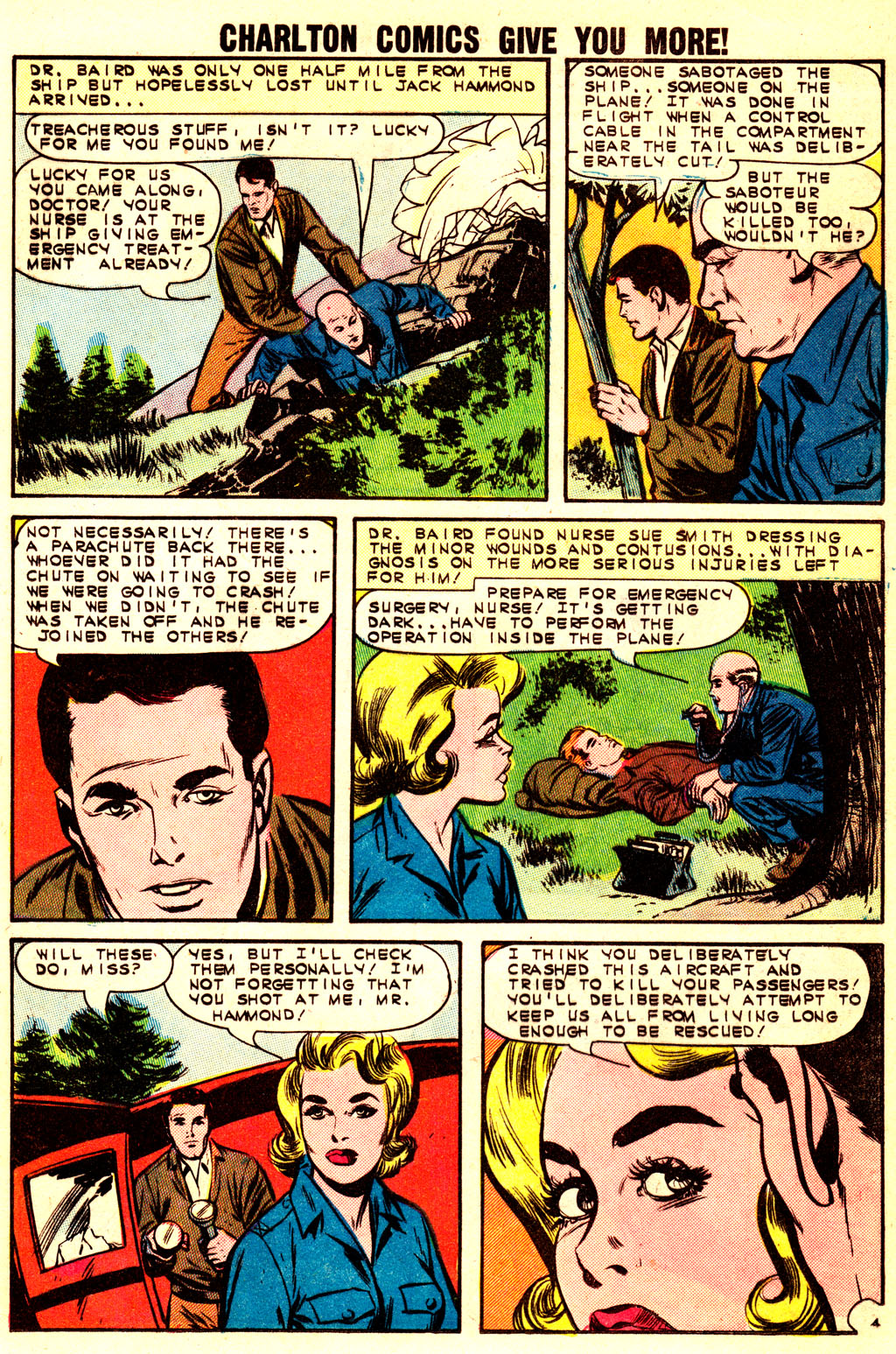


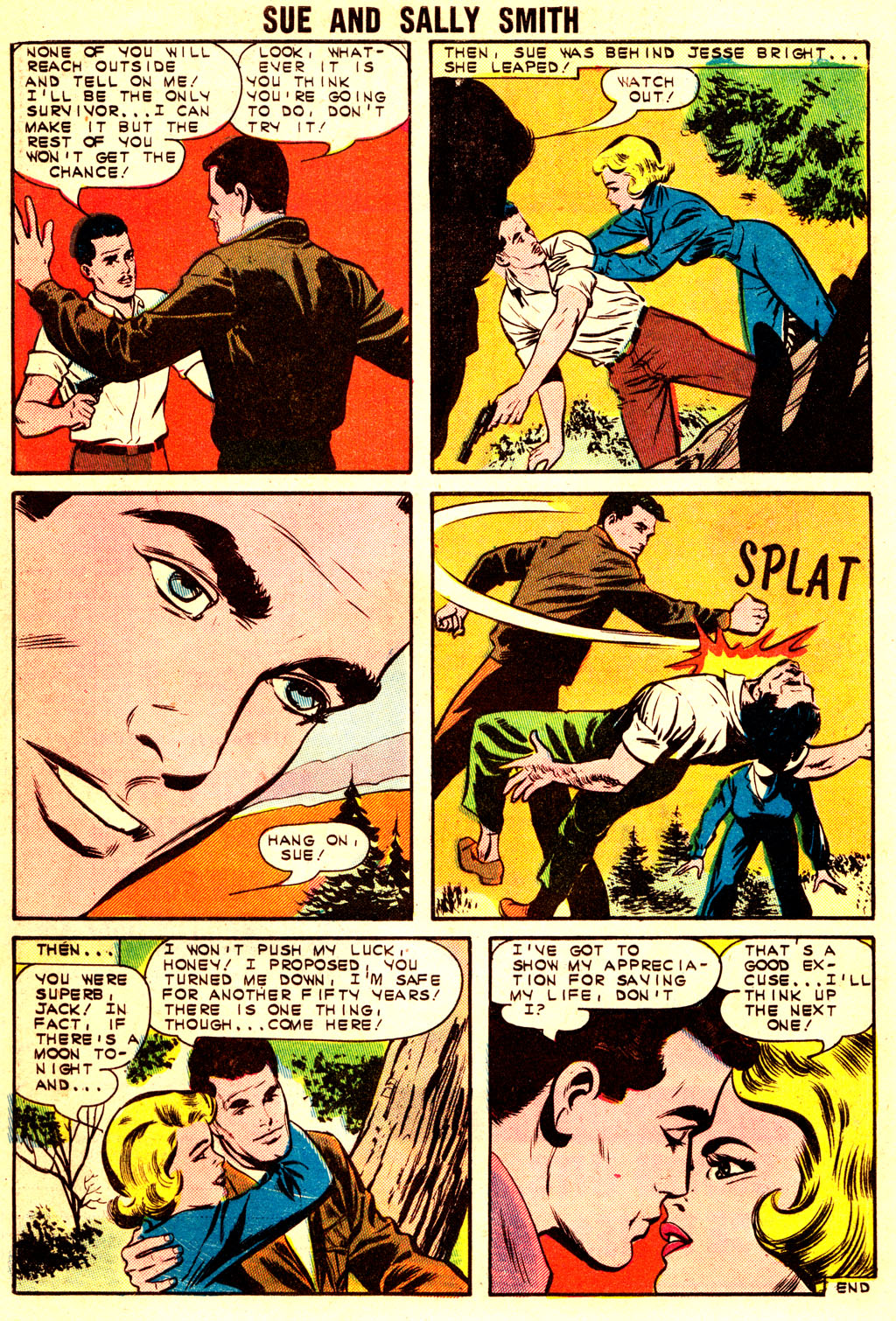
I'm only posting the stories featuring the stars of the comic here. This issue also contained the requisite bits of filler: A four-page story about a girl who liked classical music but didn't care for "the Twist" her little brother enjoyed, the standard two-page text feature to meet postal requirements ("Planet Plague"), and a one-page examination of "Wilderness Scout" Kit Carson, which has been featured in a few Charlton issues over the years.
Thursday, August 1, 2013
I Blame Society for Making Me Create These Bad Covers
Please forgive me. I was led astray by baaad people.


Subscribe to:
Posts (Atom)